Showing posts with label NJ Colonial and Revolutionary Era Newspaper Extracts. Show all posts

Wednesday, January 20, 2016

Documentation and Reconstruction of a Hybrid Style Double Breasted Waistcoat in Striped Calamanco


I'm collaborating with a fine tailor, Patrick Eckelmann, on a new 18th century waistcoat project. What I have in mind is a hybrid waistcoat that features both single and double breasted elements. It will feature a wonderful historic textile known as striped calamanco that is virtually unrepresented in the reenacting community, and the garment when finished will be suitable for several 1760s-1770s impressions.

While double breasted waistcoats fully came into their own after 1780, they were by no means unknown in prior decades. Examination of NJ runaway descriptions from period newspapers in the decade between between 1768 and 1777 reveals quite a number of individuals who wore double breasted jackets, waistcoats and vests in a variety of fabrics, as the following excerpts illustrate:

“ [1768] a double breasted swanskin jacket with black spots, and brown mohair buttons”
“[1769] two striped jackets, one of which is double breasted, without sleeves”
“[1769] a blue and white homespun striped double breasted under jacket without sleeves”
“[1770] blue double breasted [jacket], without sleeves, or lining, metal buttons”
“[1771] two snuff coloured cloth jackets, the under one short, double breasted”
“[1772] a blue double breasted vest”
“[1772] a striped Bengal jacket, double breasted”
“[1772] a cotton and worsted double breasted jacket”
“[1773] lincey Woolsey [vest] , double breasted, of a reddish colour”
“[1773] a red vest without sleeves, double breasted”
“[1775] a light coloured new double breasted under jacket, of fulled lincey”
“[1777] a blue double breasted jacket”


Occasionally such descriptions also contain references to a distinctive cut or construction:

“[1773] double breasted [jacket] , the fore parts red nap, the back parts striped lincey”
“[1773] a short lightish double breasted under jacket with metal buttons and no skirts”
“[1774] a red frize waistcoat double breasted, with pewter buttons on one side and none on the other”


There are also references to waistcoats and jackets made with calamanco, including “a striped calamanco jacket” and “a calimancoe striped waistcoat, with a number of small buttons”: both worn by Irish servant runaways in 1773. Another runaway in 1776 wore "a sleeveless jacket, with the fore parts of red serge, the back parts calamanco”

During the second half of the 18th century, calamanco was a thin worsted fabric, often striped in multiple colors but sometimes also checked, damasked, or with a satin weave. Norwich, England was famous for it.

The striped calamanco cloth that I have located for this reconstruction is a 17" by 60" bolt of fabric made by Eaton Hill Textile Works, and is closely matched to an 18th century example. It has stripes in several widths and arrangements and features an astonishing eight colors, including red, pink, yellow, two shades of green, light brown, black and white.

There is considerable variation in style, construction and fabric in contemporary runaway descriptions to support a choice of striped calamanco for this waistcoat reconstruction, and also for utilizing a different fabric for the back parts if there is not enough calamanco material for the entire waistcoat. Likewise, while small buttons covered in the same fabric as the front waistcoat panels are an appropriate choice, there is enough variation in the button descriptions in these runaway descriptions to support other options.

Regarding the pattern of the waistcoat itself, while general trends in double breasted waistcoat construction are discernible from 1750 to 1780, there is far more variety in the available documentation than might at first be suspected, and there are still exceptions to every rule. One of the earliest contemporary images of a sailor wearing a double breasted waistcoat, for example is the sketch (at left) held in the collections of the National Maritime Museum (UK). The central figure is a Scottish Captain whose underjacket appears to have no skirts and has a narrow distance between the paired rows of buttons. This is thought quite typical of such waistcoats from the 1780s onward, yet this sketch is thought to date from about 1750.


A second portrait from the same time period (below, at left) shows a gentleman in hunting dress wearing a double breasted striped waistcoat. The subject was a Welshman and President of the Society of Sea Sergeants. His collared double breasted waistcoat with flap pockets and cutaway skirts has small self covered buttons, with a single, third button in the center to close the two bottom halves and perhaps one as well at the collar. The stripes in this case are lateral.

Gwynne’s waistcoat is an early example of a variation of the double breasted style dating from at least the 1750s. It is actually a hybrid with both single and double breasted elements. Typically one or more of the bottom buttons on such waistcoats were single breasted, with those above arranged in two, widely spaced double rows. This button configuration is similar to those found on regimental coats of the 1750s but usually these waistcoats are without lapels.

The hybrid waistcoat style seems to have been popular with

sporting gentlemen like Gwynne based on surviving portraits of the period, but there is variation even among these examples, with skirts of different cuts and lengths and different numbers of single buttons below the double rows. The example at right depicting a gentleman named Francis Burdett dates from 1762-1763 and is one of a series of portraits made of fellow members of the Markeaton Hunt during this time by portrait painter Joseph Wright of Derby. Burdett's waistcoat is typical of the rest worn by his hunting companions: a hybrid with long skirts that are either squared in the typical 1750s style or just slightly cutaway. It is unlined, with two self covered buttons that close the bottom of the waistcoat and a wide double row of small buttons above.

There is actually a surviving example of a hybrid waistcoat from the collections of Snowhill Manor in Gloucestershire that dates from the 1760s.

It is made of red, yellow, cream and blue silk, lined with natural linen, and fastens with small flat self covered buttons. The fore parts are striped while the back parts are solid. The skirts are shorter and appear to be more cut away in the fashion that became popular in the 1770s. The pocket flaps lack button closures.

Although the images below may be reversed, it appears that this double breasted waistcoat was designed to fasten over the left row of buttons rather than the right. The rows also curve slightly inward as they rise toward the center and then curve out again as the approach the shoulders. There are four small buttons that close the bottom, single breasted portion of the waistcoat, and one that closes the neck. It has false side vents and a true back vent.


This waistcoat provides the template for the major design elements of our hybrid waistcoat reconstruction:

· - The front panels will be vertically striped calamanco, while the back panels may be white
    serge.
· - It will have two rows of 9 or 10 rather than 11 small self covered or thread covered
    buttons per row, arranged in a slight curve.
· - It will have at least three small buttons that close the bottom of the jacket front.
· - It will have short cutaway skirts
· - It will have two scalloped pockets without buttons and no collar.

Unlike this surviving example, the reconstructed hybrid waistcoat will be unlined, and it may either lack or include the top button to close the neck at the tailor’s discretion. Instead of silk and linen, it will be constructed of worsted calamanco and serge. It will not be reversible; that is, it will only button on one side, and it will button on the right rather than on the left.

When it is finished, this striped calamanco and serge hybrid waistcoat ought to work nicely for several of my historical impressions, including that of a 1760-1780 American merchant seaman, among whom striped waistcoats were a popular choice. I could see it working as part of my 1758 New Jersey Provincial Regiment impression as well, for no waistcoats were issued to this unit in that year and soldiers who had them would have likely worn civilian ones. It might likewise do for an early Revolutionary War American militia or even Continental Army impression, especially those units where a wide array of civilian coats were collected and distributed to soldiers. The greatest challenge may not be finding an appropriate, documented use for this 18th century garment, but reconciling its bold stripes and array of colors with the fashion sensibilities of our own era.

When it is ready, I will of course post pictures. I hope to have it available for this year's Boston Massacre. If so, look for me among the angry sailors.

Tuesday, December 15, 2015

Letter from the Forage War Sheds Light on a Forgotten Skirmish

I recently came upon a letter in the Collections of the Connecticut Historical Society written by New Jersey Brigadier General William Maxwell after a one of the many skirmishes of the so-called Forage War during the American Revolution.  The action took place on January 23, 1777 near Woodbridge, New Jersey, between Continental (and quite possibly militia forces) and a column of wagons escorted by two British regiments.  In his letter, transcribed by me below, General Maxwell chastises a Colonel Potter for not taking part in the skirmish:

"Westfield January 25th, 1777

Dear Colonel

I am really sorry that you with your Troops had not a share in the honour of the 23d for the enemy has got a very severe rub; their two Colo. & Commanders one killed the other severely wounded, 5 men left in one house and seven in another to our mercy, and one dead one left they could find, alto the wounded that could march did it; their ammunition wagons and chairs was stowed full as they could hold and we had not a man wounded and all performed with less than 200 men.  200 men of ours never came up to the action.  Had they come up we must have made them all prisoners.

The enemy is expected up today from Amboy.  I hope you with your troops will after breakfast to day, or a soon as you receive this, will proceed to Colo. Buckner’s Quarters.  I hope to Joyn (sic) you myself and if they come between us and Matesching Meeting House we will try to give them an uneasy passage.

I am Dear Colo. your most Humble servant


Wm Maxwell"
Maxwell, though a New Jersey Continental General, was at this time coordinating with both state troops from the New Jersey militia and with Continental Army forces from other states.  It was a time of great confusion, as East Jersey was still occupied by the Crown Forces and most Continental Army units were recruiting and reforming after the Battles of Trenton and Princeton.  The Colonel Buckner referenced in Maxwell's letter was Mordecai Buckner of the 6th Virginia Regiment.    Colonel David Potter, the recipient of Maxwell's letter, was, commander of the 2nd Battalion of Cumberland County (NJ) Militia, now serving as state troops far from their homes in southern New Jersey.

Potter's absence from the fight was regrettable, but Buckner's was criminal.

 In a letter to John Hancock on January 26th, 1777, Washington fails to mention Maxwell at all in connection with this skirmish, and gives credit to Buckner's Major (soon to be Lt. Colonel) Richard Parker for leading the advance while Buckner failed to come up in support.

   "On the 23d., a party of 400 of our Men under Col Buckner fell in with two Regiments of the Enemy, conveying a Number of Waggons from Brunswick to Amboy. Our advanced party under Colo. Parker engaged them with great Bravery, upwards of twenty Minutes, during which time the Colo Commandant was killed and the second in Command Mortally wounded. The people living near the Field of Action, say, their killed and wounded were considerable. We only lost two men who were made prisoners. Had Col Buckner come up with the main body, Colo. Parker and the other Officers think we should have put them to the rout, as their confusion was very great, and their ground disadvantageous. I have ordered Buckner under Arrest and shall bring him to tryal, to answer for so extraordinary a piece of Conduct."

Washington wrote to New Jersey Governor William Livingston on February 3, 1777, in which he provided a further account of the fight at Woodbridge and again failed to mention Maxwell.

"we have had two Skirmishes with large Bodies of the Enemy in which they have little to Boast of and would have had less, had not a Colo. of ours behaved Ill in each for which they are now under Arrest. In the first, two of their Regiments were opposed by our advanced Party of 160 Men, who behaved well, and if supported by the Main Body of about 260. under command of Colo. Buckner, would have done."

Buckner requested the right to resign his commission, but Washington insisted on a court martial:

    "Sir: It is not in my power to comply with your request on three Accounts, yourself, the Country at large, and the State you come from, Were the matter to remain undetermined, your Reputation must be ruined; at all events, every Officer would have reason to expect equal favor, and I shall be justly taxed with partiality. Would you reflect on the Impropriety of your Petition, you would certainly withdraw it. Resolved as I am to reward merit, and punish demerit, I shall refer your case to the judgment of a Court Martial, and shall be happy to hear that it acquits you. I am, etc."Buckner was tried at a Court Martial convened in Chatham, New Jersey under Major General Arthur St. Clair, though Washington's letters record that "Colo Buckner of the 6th Virginia Regiment who was under Arrest upon a charge of cowardice, broke his parole and went over to Bucks County, I suppose with an intent to make his Escape, but I dispatched a Troop of light Horse after him, who brought him back yesterday, and he is to take his tryal on Friday."  he was duly cashiered on February 9th having been found guilty of "Shamefully Misbehaving before the Enemy, in the Action of the 23rd. of Jan'y last" and of "Quitting his post and party in time of engagement."

Lt. Colonel Richard Parker clearly distinguished himself at the Woodbridge fight, and most contemporary accounts credit Parker with the victory.  Based on his letter to Colonel Potter, one might easily assume that Maxwell had been present, but a letter from Washington to Joseph Reed on January 24th strongly suggests he was unable to take part because his militia forces failed to arrive as ordered:

"Had there not been some mistake in point of time for marching the several brigades that were ordered upon that service, and particularly in delivering an order to General Varnum, I believe the rear of General Howe’s troops might have been a little rougher handled than they were, for if an express who went to General Maxwell the evening before had reached him in time to co-operate upon the enemy’s flank, for which purpose he was sent down the day before with a respectable force, very good consequences might have resulted from it; however, it is too late to remedy these mistakes"

It certainly sounds as if Maxwell had been meant to take part in the action of the 23rd but the absence of Potter's militia left only Parker to harass the enemy column and wagons.   Parker would serve under Maxwell once more later that year during the Brandywine campaign as part of his provisional light infantry corps. 

The identity of the two British foraging units they engaged near Woodbridge requires some sleuthing to establish based on fragmentary and contradictory records.   Rivington's New York Gazette and Weekly Mercury reported guardedly in its January 27, 1777 issue:

"A Skirmish has happened in the Jerseys between a foraging Party of the King's Troops and a Large Body of the rebels, in which it is reported, we have lost several waggons, but no authentic Particulars are come to hand."
Robert Prescott (1726 - 1815)

I am indebted to Todd Braisted who located an "Extract of a Letter from a Gentleman of Character at Morris-Town, to his Friend here [Boston] dated Jan. 30" printed The Freeman's Journal or New-Hampshire Gazette of Portsmouth, February 25, 1777.  This letter identifies the British units involved as the 28th and 37th Regiments, and is probably the source for this same information that appears in an 1810  Massachusetts Historical Society publication.  Based on theses sources, about 600 royalists formed the wagon escort moving from Brunswick to Amboy that was attacked on January 23rd near Woodbridge.   Both claim that a "Colonel Preston" was killed, though according to Todd there was no such British Colonel Preston in America.  Yet Maxwell's own letter says the regiments' "two Colo. & Commanders" were casualties, with one a fatality.

The commander of the 28th Regiment at this time was Lt. Colonel Robert Prescott, whose name is quite similar to Preston.  He survived the war, however, and I have not located any account of his wounding.   After the war went on to be a Major General by 1789 and ultimately was Governor-in-Chief of British North America in 1796.

As for the 37th Regiment, it was stationed in Rhode Island on January 23, 1777 so it is unlikely that it was the other British unit that took part in the fight near Woodbridge, NJ.  One can only surmise that someone confused the unit designation, perhaps mistaking the 33rd Regiment of foot, for example, which was based at that time in Amboy, New Jersey under Lt. Colonel James Webster, for the 37th.

Friday, May 1, 2015

Ensign Asher Levy - Jewish Patriot, Loyalist Spy (or Double Agent)?

From September, 1777 to June 14th, 1779, Asher Levy was first a cadet and later an Ensign in the 1st New Jersey Regiment of the Continental Line.  The name is spelled variously on muster return as Asher/Asser/Ashur and Levy/Lewis, but they all refer to the same person.   His pedigree is clear and he holds the distinction of being the only Jewish officer known to have served in the Jersey Line during the Revolution. 

His otherwise unremarkable service is noteworthy for being called to testify at the court martial of his commanding officer,Colonel Matthias Ogden, in early Spring 1779.  Colonel Ogden was acquitted on all charges but "the pernicious vice of gaming." Levy resigned his commission shortly thereafter, but not before adding his name to a petition from the line officers of the 1st NJ to the Governor to redress grievances about inadequate officer pay and provision. 

Asher Levy also holds the distinction, after leaving the army, of twice being imprisoned in 1780 as an enemy agent and  "notorious villain."  The minutes of the Supreme Executive Council of Pennsylvania from February 22, 1780, include the following seemingly damning reference to Asher Levy:

"A letter from Lieutenant Colonel De Hart [of the 1st New Jersey Regiment] was read, informing the board that one Asher Levy, a person of disaffected Character, was in this City, and there was great reason to believe he was a spy."

We also have two tantalizing descriptions of him from each of his two jailbreaks that add color, if not clarity, to his story.
"One Thousand Dollars Reward

Made his escape last evening over the gaol wall of Burlington, a certain ASHER LEVY, who was committed as a spy from the enemy, and also for high treason.  He is about five feet seven inches high, about twenty years of age; has short black hair, but wears a false tail: Had on a light colour'd knap great coat, lined with green baize, and a red velvet cape; a white broadcloth jacket, and black knit breeches.  Whosoever secures said villain, and delivers him to me, shall have the above reward paid by

March 25 [1780]                       Joseph Burnes, Gaoler

- New Jersey Gazette Vol. III No. 118, March 29th, 1780
"

 After his subsequent recapture, Levy escaped once more, this time making his way to New York.

Burlington August 10th, 1780

Broke out of Burlington gaol last night, two notorious villains:  The one named Joseph Heighton, about 5 feet 8 or 9 inches high, about 24 or 25 years of age; had on a lightish coloured jacket without sleeves, a pair of striped overalls and boots; had no coat or hat: the other named Asher Levy, about the same age, about 5 feet 5 or 6 inches high; had on a fashionable hat, brown broadcloth coat, jacket and breeches, a pair of new shoes without buckles.  It is supposed they are gone towards Amboy in order to make their escape to the enemy.   Whosoever takes up and delivers them at the gaol aforesaid, shall have Four Hundred Dollars for each, paid by
                                                   
J. Phillips, Sheriff.

- New Jersey Gazette Vol. III No. 138 August 16th, 1780

Joseph (Hayden) Heighton's concurrent escape with Asher Levy may have been coincidental.  He and his brother Richard Hayden were counterfeiters, and yet another brother Samuel Hayden lead a party of King's Rangers and Loyalist refugees in a raid on Woodbridge, NJ in June 1780 to kidnap some of those who had given evidence against his kin.  Joseph and Richard Hayden ended up in British occupied New York, and in November, 1783 were arrested by the Crown and imprisoned for stealing a horse and chaise.  Villainous company, to be sure, but with no other known connection to Asher Levy after he and Joseph Hayden made their escape from New Jersey.

Levy is described in both newspaper accounts as a young, well dressed man, with estimates of age that comport with his known year of birth (1756).   Asher Levy later married Margaret (Mary) Thom(p)son in occupied New York on May 22nd, 1782 and died just a few years later in Philadelphia.

What are we to make of his reversal of allegiance?  Was he a mere turncoat, or was he something more?  Could he have been a double agent?  We will probably never know, but it is worth delving deeper into what is known about his background to see what it may reveal about his chosen path.

There were fewer than 3,000 Jews in the American Colonies at the outbreak of the Revolution and they maintained close business and family connections.  Asher Levy's family origins and alliances offer potential clues to his behavior during the Revolution.

Levy came from a prosperous Ashkenazic Jewish family with deep roots in North America.  A collateral
Moses Lev y (1665-1728)
was Asher Levy's Grandfather
ancestor and namesake was among the first Jews to settle in New Amsterdam in 1654 and the only one who remained there at the end of Dutch rule despite Peter Stuyvesant's efforts to drive them from the colony. His Grandfather Moses Levy had two marriages and many of the oldest Jewish families in America come from these lines. 

By the mid 1700s, Asher Levy's nearer relations were well established in Pennsylvania.  His Uncle Nathan Levy, in partnership with his cousin David Franks, owned the ship which delivered the Liberty Bell to Pennsylvania in 1752. Asher Levy's father Isaac Levy died in Philadelphia in 1777.

In order to secure even the lowest officer's commission in the 1st NJ, a candidate needed connections.  Ensign Levy appears to have had a very good connection through his sister Esther (Henrietta) Levy's marriage to Matthias Williamson, Jr. (1752-1836), a New Jersey militia Assistant Quartermaster in 1778 but more significantly the son of militia Brigadier General Matthias Williamson of Elizabethtown New Jersey (and coincidently one of my ancestors).  Both Ensign Levy and Matthias Williamson were called to testify in Colonel Ogden's court martial in Elizabethtown in 1779, and as shall be seen, Matthias Williamson Jr. was one of the executor's of Asher Levy's will in 1785.

Oliver De Lancey, Jr.
On the other hand, Asher Levy's Franks relatives included several clear Loyalists.  1st cousin Phila Franks eloped and secretly married non-Jewish Oliver DeLancey, Jr., who would become the senior Loyalist commander during the Revolution.  Her brother David Franks was twice imprisoned in Philadelphia and finally sent through the lines to New York until the end of the war.  His daughter Rebecca Franks was the belle of numerous British balls in occupied Philadelphia during the winter of 1777-1778, and later while in exile in New York married Lt. Col. Henry Johnson of the 17th Foot.

Asher Levy was able to leave New York before the final Peace was ratified and moved to Philadelphia.  If he were truly a "notorious villain", one wonders why a clear patriot, his brother-in-law Matthias Williamson Jr., would have deigned to be an executor of his Will.  Yet here is the summary of Asher Levy's Will, drafted in the fall of 1783 and proved in August 1785.  His wife Margaret (Mary) Thom(p)son, is listed as a witness, and both his sister Esther and brother-in-law Matthias Williamson were his executors.

LEVY, ASHER. Phila. Gentleman.
September 25, 1783. August 12, 1785. T.183.
Sister: Esther [Otherwise called Henrietta].
Exec: Brother-in-Law Matthias Williamson and Sister Esther Levy.
Wit: Margret Thomson, Richard Mount, Callaghan McCarthy.

A couple of months later, the Pennsylvania Packet posted the following notice:

If a certain Asher Levy, son of Mr. Isaac Levy, of the city of Philadelphia, deceased, will apply to the
                 Printer hereof, he will hear of something to his advantage." December 9, 1783


This was in reference to his father's will of 1777, the estate of which remained unsettled as late as 1785.  By then, Asher Levy himself had died.


It is possible that Levy really was a disaffected person, but it is also possible that Lt. Col. De Hart's letter naming him as such was an elaborate cover.  As part of an extensive merchant family he had connections throughout the Western Atlantic from Nova Scotia to Jamaica.  There were plenty of spies managed by the officers of the 1st and 3rd New Jersey Regiments and Levy could have been one of these.  Then again, Colonel Ogden may have been looking for a chance to get rid of him after the court martial testimony.  Until more data comes to light we can only speculate, but there is room for reasonable doubt that his story should be taken at face value.

Wednesday, April 1, 2015

Seafaring Dress Mentioned in New Jersey Runaway Ads 1734 - 1782

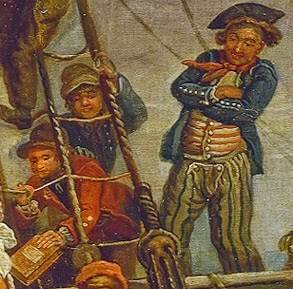
Detail from The Embarkation by John Collett,
circa 1760s, Nation Maritime Museum (UK)
Then as now, 18th century mariners were a distinctive fraternity.  Seafaring dress was clearly recognizable to contemporaries as such, though not all who wore it were active seamen and plenty of waterman plied their trade in landsmen's clothes. 

A detailed, ongoing study of documentation for sailor clothing of the period can be found at the excellent British Tars blog, and there has been fine research as well by such living history groups as Munro's Battoe- men and H.M.S. Somerset.

To add to this body of knowledge, I have analyzed colonial and revolutionary era newspaper references to sailor clothing between 1734 and 1782 as compiled and recorded in the New Jersey Archives.  I offer here a short assessment of these data, followed by every clothing description listed by year.

Blue was the most common, but by no means the only sailor jacket color. There are 16 references to blue sailor's jackets, most of which date from the mid 1760s or later.  There are also five references to brown sailor jackets, only one of which from the revolutionary-era.  There are four green, four light coloured, two black, two grey or lead coloured, one snuff-coloured, two that were either striped or spotted, one dark coloured, one black and blue and one striped red and white. 

Men from the same ship sometimes wore clothing of the same color and material provided from the ship's store.   In 1766 two murderers wore "light coloured sailor's jackets lined with white", while in 1763 six Scotsmen who had recently been transported from Leith on the Ship Boyd, Captain Dunlop, subsequently ran away taking with them "sailor's new short blue jackets, lined with white flannel."  Five men who ran from the Hannah, James Mitchell, Master, in August 1773 were wearing very poor and ragged clothing, but one is described as an apprentice and the others are unlikely to have been sailors, for the overcrowded Hannah had just crossed from Londonderry to Philadelphia with 520 Irish passengers.

Men Loading a Boat With Barrels by Samuel Scott (1702-1772)
Yale Center for British Art
Various textiles were used for sailor jackets.   Outer clothing made sailor fashion was often coarse or napped wool fabric like bearskin or kersey with properties suitable for resisting wind and water.  Thick cloth, Duffield, German serge, homespun and broadcloth are also mentioned in the New Jersey runaway ads, as is a swanskin flannel jacket.  Buttons when mentioned are quite varied.  Where a lining material is described, flannel or woolen is mentioned, colored either white or red.  Where a binding is noted, it is either white or a lighter color than the coat material.  Since jackets with binding along the edges and sleeve placets were commonly associated with seafaring dress, these may be under-represented in the runaway descriptions that simply mention sailor jackets.  

There were no Pea Coats, but there were Pea Jackets.   Possibly derived from the Dutch or Frisian "pijjekker" meaning a coarse cloth jacket, pea jackets have been associated with American and European sailors for centuries,  first referenced in the Boston Gazette in 1720.  The earliest reference to sailor clothing in my New Jersey study is to "an old sea-pea jacket, lined with red, and the skirts somewhat cattle eaten" worn by a runaway in 1734.  Two more references in the 1740s describe pea jackets and they continue to appear in these records through 1772.  There are nine in all. How a pea jacket at this time differed from a sailor's jacket is not apparent from the newspaper ads, nor whether they were broad lapelled and double breasted as was typical of later Pea Coats. One runaway servant in 1772 wore a long surtout over his pea jacket.  They are described in many different colors, but the only reference to cloth is a "dark kersey pea jacket, without lining."

The Sailmaker ticketing the hammocks on board [the Frigate] Pallas
by Gabriel Bray, November, 1774, National Maritime Museum (UK)


There are some early mentions of short jackets, But not enough to discern a trend. Short jackets, which may or may not have had skirts, are mentioned as early as 1763 in the NJ runway ads, and again in 1768.  On the other hand, a runaway in 1772 wore "a large blue sailor jacket, lined with white flannel, somewhat tarry."  Most descriptions do not mention jacket length at all.  Likewise, there are just two mentions of double breasted sailor jackets.

Other items of distinctive sailor dress are infrequently mentioned
.  Since most of the newspaper ads in this study describe runaways who happened to be wearing sailor's jackets but were in service on land, caution is needed when assessing their other clothing as indicative of nautical wear.  Three wore "sailor trowsers", one described in 1751 as wide sailor trowsers and fustian breeches under them.   The two murderous sailors who waylaid a man on the road in 1766 left behind their incriminating clothes: "one shirt and sailor's frock, both bloody, two pair of trowsers, one bloody, and two small marling spikes".  In 1768 A horse thief in a sailor jacket wore "long striped Cotton trowsers" and was described as having served on a man of war. 

There are just a couple of references to caps or hats.  Two of the hats have bound edges, one that is probably not cocked,  and another very unusual one worn by a slave from Barbados in 1769 who was apprehended in seafaring dress wearing "a white hat with red lining, yellow loop and button."  Two men wore caps - one of the murderers in 1766 had on "a sailor's cap", and  an Irish servant in 1768 who wore "a regimental cap turned up with red".

There are plenty of watermen in these NJ runaway ads who sailed and/or stole boats and wore regular clothing. Any sailor clothing that was described is listed below.

Scott Lance, Munro's Battoe-men
Washington Crossing, 2013

Sailor Clothing mentioned in NJ Runaway Ads 1734-1782


1734 an old sea-pea jacket, lined with red, and the skirts somewhat cattle eaten
1742 an old black pea jacket, mohair buttons, lined with white flannel
1744 a dark kersey pea jacket, without lining
1749 Blue Duffield sailor’s jacket, and a striped under jacket
1750 a snuff coloured pea jacket
1751 A brown pea jacket, and a blue one under it..
         ...wide sailor trowsers and fustian breeches under them
1756 an old bearskin [vest] made sailor fashion, patched on the elbows
1762 a redish brown sailor’s jacket
1763 a kersey sailor’s double breasted jacket, with horn buttons
1763 [a number of] sailors new short blue jackets, lined with white flannel
1764 an old lead coloured pea jacket, pieced on the sides with black
         (to make it big enough for him)
1765 a thickset coat, sailor’s trowsers, a great coat, and old hat
1766 [Murderers, two men dressed like sailors]
         light coloured sailors jackets, lined with white, the tallest
         had a sailor’s cap, the smallest a hat
        (leaving in the field one shirt and sailor’s frock, both bloody,
         two pair of trowsers, one bloody, and two small marling spikes)
1766 Irish servant an old blue sailor’s jacket, bound with white,
         with horn buttons, a red under jacket without sleeves, bound with white
1768 a sailor’s blue waistcoat and under waistcoat, a pair of new buckskin
         breeches, new fulled stockings, and a felt hat.
1768 a short blue sailor’s jacket, with the sleeves taken out, blue half thick
         trowsers, linen ditto
1768 a sailor’s napped vest
1768  a regimental cap turned up with red, an old brown jacket made
          sailor fashion, tow trowsers
1768  black and blue homespun vest, made sailor fashion, slashed sleeves,
          lined with flannel, with horn buttons, long striped trowsers
          (later described as: a new double breasted jacket, black and blue
          broadcloth, with slash sleeves, lined with flannel, and
          horn buttons…long stripped Cotton trowsers)
1768 a blue sailor’s jacket
1768 a thick cloth jacket light colour’d, lined with woolen, made sailor fashion
1768  a check shirt and a pair of white tow trowsers, a sailor’s brown jacket,
          a streaked vest
1769 a swanskin flannel jacket, made sailor fashion
1768  a sailor’s jacket with lace over the seams
1769 a blue sailor’s jacket, much worn and faded
1769  he was taken up in a seafaring dress, with a white hat, red lining,
          yellow loop and button, who says he is a slave of John Christian,
          of Bridgetown, Barbados,
1770 coarse light coloured cloth jacket, lined with red, made sailor’s fashion
1771 four sailor jackets, two blue, the others striped or spotted
1771 a large blue sailor jacket, lined with white flannel, somewhat tarry
1771 Green pea jacket and a check shirt
1771 a blue pea jacket
1772 a blue cloath sailor’s jacket
1772 an outside green pea jacket, and a red under one, a long blue
        surtout coat, long Oznaburg trowsers, and new shoes, a checked shirt,
        a very small rimmed beaver hat, and a Black silk handkerchief
        round his neck
1773 two waistcoats, sailor fashion made, one green the other grey
1773 a blue sailor’s jacket
1774 Two green cloth jackets, the upper one a sort of nap, made in the
          sailor fashion
1774 one homespun bearskin [ships] black jacket, one light coloured
         worsted and wool ditto, no lining in either, two ozenbrigs shirts,
         one new, the other half-worn, one pair of old leather breeches,
          new tow trowsers, black yarn stockings, two pair of shoes,
          about half worn, a good felt hat, almost new, and an old ditto,
          has been bound round the brim
1777  a brown sailor jacket, and an under ditto, near the same color,
          of German Serge, bound with binding something lighter; homespun
          shirt and trowsers, an old castor hat.
1777 a blue jacket made sailor fashion, blue breeches, a round hat
1778 thickset coat, striped linen jacket, sailor’s trowsers and thread stockings
1779 a sailor’s blue jacket and breeches
1780 striped red and white sailor’s outside jacket


Tuesday, March 31, 2015

"So that the subscribers may have the child again, and the parents convicted of the theft"

Sometimes a single reference in an old newspaper underscores how very different the mindset of an earlier time was from that of our own time.

"Lost from the subscriber, living on Raccoon Creek, in Woolwich township, Gloucester county, West New-Jersey, on the night between the 9th and 10th of this instant October, an indented female child; her name is Polly Murphy, very near five years of age, pretty tall for her age, of a fair complexion, has ruddy cheeks, grey eyes, light hair, and a small scar on her forehead; had on an almost new homespun lincey petticoat, with red, brown and yellow stripes, turned up round-about, a red ragged woolen short gown, and a coarse ozenbrigs sh
ift...¹ "

As a parent reading this notice from 1775, my heart went out instinctively to that lost child, remembering a cold November when my not yet three-year-old daughter went out into the night in her stocking feet - having decided to follow her mother's car to the library - and the panic I felt until she was found, safe, but half a mile away.  My sympathy is naturally with the parents of Polly Murphy, but they were not out looking for their child.  Her master was.


"...It is supposed she has been taken away by her parents, who stayed that night with the subscriber, and with the child disappeared that morning.  The father’s name is Henry Scharff, has a lean face and thin hair, had on an old, worn out blue coat; the mother is a lusty, hearty woman, of a fair complexion, has big lips, and black hair, and is big with child.  Whoever takes up the above persons with the above described child, and secures them, so that the subscribers may have the child again, and the parents convicted of the theft, shall have five pounds reward, or for the child alone three pounds, and all reasonable charges paid by   ANDREW MINTZ"
[Pennsylvania Gazette October 18, 1775]

18th Century America's cultural and class distinctions are stark in this run-away advertisementFrom Mintz's perspective, the poor white parents of Polly Murphy have taken advantage of his hospitality and broken a binding contract by removing their five-year-old daughter from her indenture.  Readers of the newspaper would be expected to view the father, with his different surname, and the pregnant, probably Irish mother, as dishonest as well as unfit parents from a societal underclass. 
Hard information about Andrew Mintz is very hard to come by.  This single newpaper ad from 1775 is all that I have been able to find .  Intriguingly, Mintz is an Ashkenazic or eastern European Jewish surname.  Sephardic or "Spanish" Jews were more common in 18th Century America than the Ashkenazim, though there were a few of these.  He could have converted to Christianity, as did my ancestor Eleazer Cohen, a merchant from Amsterdam who lived in Philadelphia at this time. 

More likely Mintz could just be a German name
like Müntz that happened to be spelled like a Jewish one.  There was a Benedict Müntz who died in Philadelphia in 1764 whose name was also spelled Mintz.  These Mintz's were not Jewish, and intermarried with Moravians.


Sometimes even very young children like Polly Murphy were bound to service when their families could not afford to support them.  These indentures were long, and did not include niceties such as the option for early termination if the circumstances of the parents improved.  They had no recourse if they just wanted her home again.  Their child became chattel.

This was a common condition in 18th Century America, a form of long-term white slavery at a time when the permanent enslavement of black people was well established.  Appallingly, it is also a form of slavery that exists in different but still recognizable forms today, with bonded debt slavery and child labor affecting millions of people around the world.

________________________________________________________________________


1.  Documents Relating to the Colonial History of the State of New Jersey, First Series --Vol. XXXI
Extracts from American Newspapers Relating to New Jersey for the Year 1775
, Edited by A. Van Doren Hon Eyman, Somerville, N.J. : The Unionist-Gazette Association, Printers, 1923.