Wednesday, November 4, 2015

"His enterprising disposition and thirst for honor led him beyond the bounds of true bravery or conduct." Captain John Flahavan of the 1st New Jersey

John Flahavan was an officer in the 1st New Jersey regiment of the Continental Line.  He was an Irish catholic (born in County Waterford) whose family settled in the American Colonies prior to the Revolution.   He began his service in the Revolution as 2nd Lieutenant in Captain Daniel Piatt's company of the 1st NJ.   John Adams records an early encounter with Flahavan in a December 10, 1775 diary entry:

"1775. Decr. 10. Sunday. Rode from Bristol to Trenton, breakfasted, rode to Princetown, and dined with a Captain Flahaven, in Ld. Sterlings Regiment, who has been express to Congress from his Lordship.

Flahaven's Father lives in this Province. He has lived in Maryland. Says that the Virginia Convention granting the Scotch Petition to be neutral has done all the Mischief and been the Support of Lord Dunmore. He says the Scotch are in some Parts of Virginia powerfull—that in Alexandria he has heard them cursing the Congress and vilifying not only their public Proceedings but their private Characters. He has heard them decrying the Characters of the Maryland Delegates particularly Chase and the Virginia Delegates particularly Lee, Henry and Washington.

"
Flahavan was not, at this time, the holder of a Captain's commission, and various 19th century compilations of his service record tend to be confused and misleading.   It appears that he remained a 2nd Lieutenant when the 1st NJ d began to reenlist men for its 2nd establishment in late November, 1776.   He may have been on recruiting duty for the 1st NJ when Washington selected him to lead a forty man detachment at the head of Sullivan's column during the attach on Trenton.

"Captain Washington and Captain Flahaven, with a party of forty men each, to march before the divisions and post themselves on the road about three miles from Trenton, and make prisoners of all going in or coming out from Town."It is not possible to determine whether any of the men under Flahavan at Trenton may have also belonged to the 1st NJ, but Washington's order amounted to a promotion in the field for Flahavan.  It was an honor for Flahavan but may have created some difficulty in the regiment which already had its full compliment of company officers.  Historian Larry Schmidt believes that Flahavan's was essentially a 9th company in Ogden's 1st NJ in the first half of 1777. 

"Flahaven's company was essentially a ninth company from January 1777 to mid-1777. I think the remaining men (if any) were reassigned. According to documents in Piatt's orderly book, Flahaven commanded the fifth company (after D. Piatt, Longstreet, Baldwin, and Morrison) in late 1777/early 1778. Another roster states Flahaven's company is sixth, the difference being the addition of Polhemus as being senior captain, Piatt 2nd, etc. Cyrus DeHart was Flahaven's 1st lieutenant (presumably company commander during Flahaven's absence), Jesse Baldwin the 2nd lieutenant (Larry Schmidt: Personal Communication)."

In February, 1777, Captain Flahavan was definitely on recruiting duty.  Washington's General Orders of February 24th given at Morristown, NJ state: 

"The troops of Genl St Clair’s Brigade are, as soon as the weather will permit, to be drawn together and quartered as near this town, as possible: All the Recruits of Col. Ogden’s Regiment, now quartered at Troy, and elsewhere, to be immediately called together, armed and accoutred; they are to join Genl St Clair’s Brigade, and to be quartered with them. The strictest Attention must be paid by the officers, to the Arms & Ammunition belonging to their different Corps, to see them frequently examined, and kept in good Order, for Action. All Recruits raised by Capts. Morrison & Flahaven to join Col. Ogden’s Regt ’till further orders."

This was during the period known as "the Forage War" in New Jersey, in which both Continental detachments and militia units regularly harassed British outposts and forage parties.   Elements of the 1st NJ from time to time were involved in these skirmishes, and on the night of April 24th, Captain Flahavan lead a force against a piquet post near the British garrison at Amboy.  Accounts of the action vary, but the result was the capture of Flahavan and nearly all the men in his command. 


Plan of Perth Amboy 1777
Col. Israel Shreve of the 2nd NJ Regiment recorded in his diary: "Thirsday the 24th at night Capt. Flahaven of first Jersey Regt. with upwards of 20 men were Taken or kiled within the Enimy Pickets All but one that were Left Alone to tell the News..."  Surgeon's Mate Ebenezer Elmer of Shreve's Regiment offered his own assessment of the affair:  "Thursday night Capt. Flahaven went out with 20 men, but unluckily getting, as was supposed, within their lines in the dark and rain, not so much as one escaped to tell the fate of the rest...some commended him as being a very brave officer, others disapproved the action and his conduct upon the whole.  I believe his bravery was indisputable, but his enterprising disposition and thirst for honor lead him beyond the bounds of true bravery or conduct."

Major General Adam Stephen wrote to Washington on April 26th:

"Capt. Flahen of Col. Ogdens Regimt, was orderd on a patrol the night before last - He pickt up Some pensylvanians, & Voluntiers, it is Supposd to the Number 25, for I can get No Certain Acct from [Lt.]Col. Dehart [of the 1st NJ] or Othrwise - Made an imprudent Attempt it is Supposd, wt. more Courage than Conduct; & is lost, with all his party, killd or taken, or how he Managd utterly unknown - I have orderd that no project Shall be Undertaken without the Approbation of the Officer Comma[n]ding the Corps; & that the partisan shall not keep roads leading to the Enemys post - Nor patrols go Constantly the Same Way -"

Stephen was clearly trying to distance himself from Flahaven's action, knowing that Washington had forbidden independent initiatives of this sort by junior officers.  It would be interesting to know the identify of the "Pennsylvanians" with Flahavan.  The Jersey Brigade would soon be in Stirlings, rather than Stephen's Division, and their sister brigade by June, 1777 would include the 3rd, 6th, 9th and 12th Pennsylvania under General Conway.

An anonymous American prisoner released on parole gave the following account on June 20, 1777:

"Capt. Flahaven was taken within 200 Yards of the Barracks at Amboy - He had attacked the Picketts and after firing 15 rounds each Man, had near taken the whole Party, but unluckily a Scouting Party on their return, came on their Back & took the whole of them."
The British accounts of the affair, while stressing the bravery of the picket, indicate that the engagement continued for some time. The Scots Magazine (Vol. 39) reprinted a letter from an unidentified officer in the 46th Regiment who wrote to a gentleman in Dublin;


"A very spirited action happened here on the [2]5th of April last.  Lieut. Stanley, of the 55th regiment, being detached with a part of the 4th Brigade, consisting of thirty men, as part of the picquet of that brigade, Was early in the morning attacked by a party of the rebels, near double his number, under the command of one Flahavan, who is a captain in the rebel-army.  Lieut. Stanley stood his ground, and after some minutes close engagement, totally routed the rebels,  killed an ensign and several men, and took captain Flahavan and twenty-seven men prisoners.  On the first of May Leit. Stanley received the thanks of the Commander in Chief.”  

Lieutenant Edwin Thomas Stanley, a young Irishman in Captain Trevor's Company of the 55th Regiment of Foot, had recently been commended
on April 20th Major General Vaughan for a similar action.  This time he and several other officers were singled out by General Howe for special mention -

"Head Qrs:  Amboy 30th: April 77 ...
         The Commander in Chief Desires His Thanks may be given to Leiut: C Millan Acting Majr: of Brigade Leiut: Stanley 55th Regt. Ensign Angus M'Donald of 71st Regt: Capt: Albertie & Leiut: Albertie of the 3rd Regt: of Waldeck, and the Soldiers under their Command for their Spiritd: Beheavour and good Conduct near perth Amboy in the Jerseys on the morning of ye 25th: Inst: -"


The earlier commendation from General Vaughan also acknowledged these same officers.

Captain Flahavan might have expected to be housed on parole in decent quarters while awaiting exchange, but the circumstances surrounding his conduct during the fight lead to a very different outcome.  He was accused of deliberately breaking the thigh of one of the sentries whom his force had captured before they, in turn, were overwhelmed.  Colonel Ethan Allen, himself a prisoner held in close confinement in New York, references Flahavan's plight in his subsequent narrative of his captivity:

"...it was nevertheless at the option of a villainous sergeant who had the charge of the provost, to take any gentlemen from their room, and put them into the dungeon, which was often the case: At two different times I was taken down stairs for that purpose, by a file of soldiers with fixed bayonets, and the sergeant brandishing his sword at the same time, and having been brought to the door of the dungeon, I there flattered the vanity of the sergeant, whose name was Keef, by which means I procured the surprizng favour to return to my companions; but some of the high mettled young gentlemen could not bear his insolence, and determined to keep at a distance, and neither please or displease the villain, but none could keep clear of his abuse; however, mild measures were the best; he did not hesitate to call us damned Rebels, and use us with the coarsest language. The captains Flahaven, Randolph and Mercer, were the objects of his most stagran (sic) and repeated abuses, who were many times taken to the dungeon, and there continued at his pleasure. Captain Flahaven took cold in the dungeon, and was in a declining state of health, but an exchange delivered him, and in all probability saved his life...."

The American Commissary General of Prisoners, Elias Boudinot, wrote to Washington on June 26th, 1777, about the plight of Flahavan and several other officers who were prisoners in New York:

"...there is Evidence of the greatest Cruelty being used towards several of our unhappy Prisoners, and particularly to Capt. Van Zant, Major Pain, Capt. Flahaven, Capt. Vandyck, all of whom are confined in close Goal together with the Honble John Fell Esqr. lately taken from Bergen County—That several of our Officers who have lately had the small Pox in the Goals, have been suffered to languish (one of whom died) with out the least aid either as to Physick, Provision or other necessaries—That in general the daily Rations are not sufficient more than barely to keep the Prisoners from starving...."It was not until February, 1778 that Boudinot was able to do anything about Flahavan's situation.   During a visit to New York, he recorded in his diary:

"The charge against Captain Flahavan, that he broke the thigh of a soldier with the butt of a gun, after he was shot, is positively denied by him, and Mr. Loring acknowledged the man's leg was broken by a ball...Captain Flahavan was surrounded and did not surrender, and was constantly fighting for fifteen minutes after the soldier was struck by the ball."Boudinot was able to secure parole for Flahavan, who remained in British hands until he was exchanged in November, 1778.  He resigned a few months later.


John Flahavan began a very different kind of Revolutionary service in 1779 in Philadelphia, where he and his brother Thomas went into partnership as investors in a number of privateering enterprises.  The firm of John Flahavan & Co. outfitted the Pennsylvania Schooner "Hope" of 6 guns on August 18th, 1779 with a Letter of Marque under Captain Thomas Ward, and the following year on March 3, 1780 the Pennsylvania Schooner "Sally" with 2 guns and a crew of 10 under Captain Uriah Smith went privateering with Flahavan's backing.  Fellow catholic John Walsh was captain of another Flahavan vessel, the 50 ton Schooner "Dolphin" with 6 guns and 11 crew, that made two cruises in 1781.   John and Thomas Flahavan also owned and bonded for 8 gun privateer Brigantine "Betsey" on December 28, 1781, with a bond of $20,000 and a crew of 20 men under Captain George Fleming.

Flahavan belonged to St. Mary's church in Philadelphia and several of his family members are buried there.  Neither he nor his brother Thomas ever married.  Near the end of the war, John Flahavan made a voyage to Holland to advance the mercantile interest of the family firm.  On January 1783 he embarked on his return yoyage to America, but the vessel vanished without a trace.  The following year, a letter from the firm, now called  Flahavan and Willcox with the addition of his brother-in-law to the partnership, records the family sorrow at his loss:

"It grieves us to inform you that our dear brother John Flahavan sailed from Ostend Jan. 25th, 1783, & since then have no acct. of him; therefore we gave him over for lost, as there is no account from the vessel or crew..."




Friday, June 5, 2015

"After getting what arms and arminition (sic) they could find, and what plunder they pleased": The Final Fight of Shay's Rebellion (Part II)

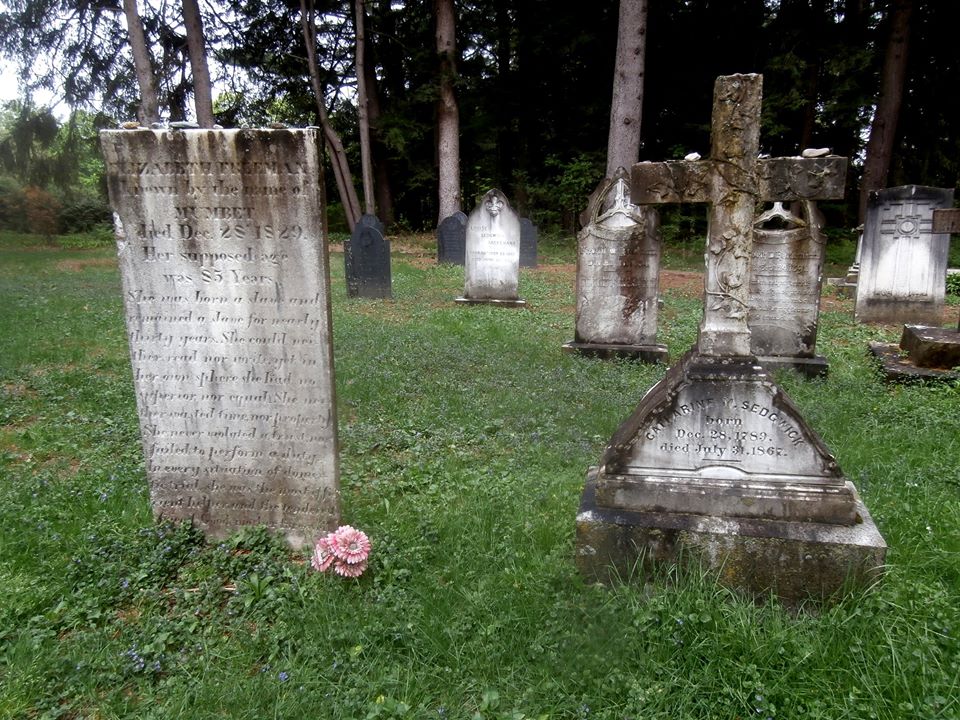
Theodore Sedgwick memorial stone
Stockbridge, Massachusetts
Captain Perez Hamlin's first move during the night of February 26-27, 1787 with the rebel forces under his command was to cross over from New Lebanon, New York into West Stockbridge, Massachusetts.  Many of Hamlin's fellow insurgents were from this very community, including at least 21 subsequently taken prisoner in the aftermath of the Sheffield fight that afternoon¹ -14 of whom were subsequently brought up on charges.

The impetus for this incursion may have been the opportunity presented by the withdrawal of most of the Commonwealth's troops from the region on February 21st after their terms of enlistment expired.  There was also a field piece that they may have hoped to capture, though it had already been removed to Pittsfield and was beyond their reach².  Finally, there was a score to settle with Theodore Sedgwick and other government supporters in the adjacent town of Stockbridge, and that is where Hamlin turned next with approximately 120 men under arms.  According to historian Lion G. Myles, Sedgwick was a particular target³, but there were many other loyal citizens in Stockbridge whose persons were tempting hostages and whose properties invited plunder. 

At this stage in the Rebellion, the "Regulators of Government" were on the defensive.  They had lost much of their unit discipline and their political and military aims had given way to marauding and revenge.  A 1938 newspaper article on file at the Pittsfield Atheneum references old court records - rediscovered by WPA workers -  that describe some of what took place when the insurgents reached Stockbridge that morning.

Isaac Marsh would bring charges against Peter and Nicholas Brazee of West Stockbridge, Daniel Owen 
Elizabeth Freeman and Catherine Sedgwick memorials,
Stockbridge, Massachusetts
of Tyringham, and Isaac Vosburgh, Jr. of Sheffield for housebreaking and theft that day of

"a silver mounted sword valued at six pounds; one gun bayonett(sic) valued at one pound sixteen shillings, one powder horn and cartridge box valued at twelve shillings". 

These items were of military value, but these four men also entered the house and stole from Erastus Sergeant

"personal effects and clothing therefrom to the value of 13 pounds, including a beaver hat valued at two pounds, a shirt worth ten shillings, and did damages to the house of around six pounds." 

At Theodore Sedgwick's house (from which the owner had wisely decamped on the news that he was a target of the incursion), the same four men stole numerous items, though they famously missed the family silver thanks to the quick thinking of former slave Elizabeth "Mumbet" Freeman. Nevertheless, they made off with

"a mare valued at 30 pounds; 50 pounds of beef worth three cents a pound; two firearms valued at 30 pounds;  a silver mounted hanger worth six pounds; a broadsword valued at seven pounds, four shillings; a horse pistol worth one pound and 10 shillings and three shirts worth 2 pounds and 14 shillings, a total of 74 pounds and six shillings for lost articles and damage done."

They also took a gelding worth 20 pounds and a saddle worth six from Samuel Kirkland, among other items.

Daniel Owen was also charged, along with Stephen Seyley, Aaron Knapp, John Minclair and Asahel Newell (all of West Stockbridge) and Nathaniel Austin of Sheffield with the theft from Silas Pepoon, among other items, of "a gun valued at 45 shillings and a cartridge box worth 12 shillings.

Similar acts were repeated throughout the town as the insurgents went from house to house.  Other sources tell us that from Captain Josiah Jones they stole a considerable amount of wampum, while at Timothy Edwards' place they appropriated and consumed a great amount of alcohol, which only contributed to their marauding.

They also took many citizens prisoners.   Dr. Erastus Sergeant described his ordeal a few days later in a letter to Major General Shepherd dated March 5, 1787:

"...On Tuesday morning the 27 ulto. about daybreak I had my house surrounded by twelve armed men, with a demand of enterance (sic) and surrender to Shays with the most horrid imprecations and diabolical visages that it is possible to possess the human appearance before we could have time to determine whether it would be best to grant them enterence (sic), they drove their bayonets thru the window of my lodging room and by repeated thrusts broke the sash and 6 or 8 lights of glass, in the room I, my wife and small children lodged, then with the same degree of violence burst an outside door and an entery (sic) door which led into the same room, pointed the bayonet to my wives breast, with a demand of arms and arminition (sic) at the same time they had found enterance (sic) into almost every room of my house, after getting what arms and arminition (sic) they could find, and what plunder they pleased, which consisted of cloathing (sic), silver buckles some cash hats etc etc they ordered us to preparte to march immediately to head quarters, which was then at Mr. Bingham [the current Red Lion Inn], where I found almost all my neighbours in the same unhappy situation.  The commanding officer, Capt. Hamlin, informed me I must go with him and gave me permission to return home and take a horse or sleigh and what other comforts I pleased, which I considered as a very great indulgence, they plunders 6 horses and mounted them as videts and marched out of town sun almost two hours high in the morning with 32 prisoners, we went to Barrington where they were joined by a number more, our Friends at Barrington got information timely to make their escape to Sheffield..."


Solomon Glezen Stone, Stockbridge, Massachsuetts
Other prisoners of the Shayites included twenty-six-year old school teacher Solomon Glezen, jr., who would be killed in the crossfire during the fight that afternoon at Sheffield.   Also taken captive was Judge Jaheel Woodbridge, whose son Timothy was just three year sold at the time and recalled the event in later life as one of his earliest memories.  Timothy Woodbridge remembered

"...seeing a number of brutal soldiers with their green boughs (the insignia of rebellion) waving over the bed where my father and I lay.  The dreadful gleam of their arms was reflected by the burning lights in the room.  They demanded the surrender of my father, and I shrieked in an agony of terror as my father passed me between the guns to the arms of my sister.  They plundered the house most unsparingly, and continued these deprecations for some time - going from house to house, frightening the inmates unmercifully..."

Other prisoners of Hamlin's men taken at Stockbridge included a number of leading citizens and their family members, among whom were Moses Ashley, Ephraim Williams, Silas and Daniel Pepoon, Edward Edwards, Henry Hopkins, Deacon Stephen Nash, jr., Henry W. Dwight, Jonathan Woodbridge, Silas Whitney, Captain Joshua Jones and Joshua Jones, Jr.

The insurgents left Stockbridge with their prisoners and plunder and headed south toward Great Barrington.  The alarm had been raised and pursuit could be expected, but there were friends of the Regulators to be freed from gaol before crossing back over into New York and beyond the jurisdiction of the Bay State.  The next post in this series takes up the story in Great Barrington and the response of loyal militia forces to Hamlin's incursion into Berkshire.
_______________________________________________________________________________

1.  "List of Prisoners taken at Sheffield 27 Febr' 1787", Benjamin Lincoln Papers, Massachusetts Historical Society
2.  Starkey, Marion L. (1955) A Little Rebellion; Alfred Knopf: New York;  pg. 176
3.  Myles, Lion G. (2002) "Shay's Rebellion in the Housatonic Valley"; Upper Housatonic Valley Heritage Area pamphlet, National Park Service.
4.  "Shays Rebellion Recalled By Old Court Records" (March 22, 1938); courtesy of the Pittsfield Atheneum local history collection, Pittsfield, Massachusetts
5.  "Extract of a letter from Hon. General LINCOLN, to his Excellency the GOVERNOUR, received last evening" - Pittsfield March 3d. 1787


Monday, May 18, 2015

"If redress cannot be had without, it is Virtue in them to disturb the government.": The Final Fight of Shay's Rebellion (Part I)

The last significant "battle" of Shay's Rebellion lasted just about six minutes and did not even involve Daniel Shays. It was a sharp skirmish, nonetheless, fought in the snow on a lonely road in Sheffield, Massachusetts on the afternoon of February 27th, 1787.

There is a monument in local marble erected in 1904  near the site of the engagement (right alongside the Appalachian Trail), but few in the region today understand the event it commemorates or its national significance in the months leading up to the federal Constitutional Convention.

This brief fight in Sheffield between local militia and their disaffected neighbors resulted in as many as five fatalities and a considerable number of wounded - nearly all of them rebels - with at least sixty men taken prisoner by the government forces.  Exactly how many casualties were sustained is difficult to determine, particularly the names of those who were wounded, though I have been able to confirm the identities of four of five men reportedly killed or mortally wounded, and have located the graves of the two men who died on the government side.  The identity of the fifth man, supposedly one of the insurgents, remains stubbornly elusive.

In researching this series of posts on the Sheffield fight I investigated primary source material available online, but also archival information that required a visit to the Pittsfield Athenaeum, and several hours spent exploring the oldest sections of Berkshire County cemeteries.  This first article discusses events leading up to armed conflict in the Berkshires and the backgrounds of the insurgents who fought against the government at Sheffield in 1787.

The Shayites were "regulators of government" in the tradition of other agrarian revolts that date back to the 1760s in the American Colonies.  More locally, the border region of western Massachusetts and Eastern New York was the intersection of rival land claims and overlapping patents that had erupted in violence between landlords and tenants on both sides of the Taconics prior to the Revolution.  In the early postwar years, a combination of ruinous debt, economic hardship and longstanding resentment of unresponsive political power centered in Boston brought things to a head in Berkshire County in early September, 1786.  

A local sympathizer of "regulation" who was himself from the governing class - Dr. William B. Whiting,  Chief Justice of the Court of Common Pleas in Great Barrington - circulated an essay among his close confidants at this time entitled "Some brief Remarks on the present State of publick affairs".  Tellingly, Whiting wrote this unpublished piece under the pseudonym "Gracchus", a reference to plebeian Tribune Tiberius Sempronius Gracchus whose agrarian reforms sought to transfer wealth to the Roman poor.   Later judged to be seditious libel, Whiting opined;

"Therefore, whenever any incroachments (sic)  are making either upon the liberties or properties of the people, if redress cannot be had without, it is Virtue in them to disturb the government."

A few days later on September 12th, 1786, a large gathering of regulators stopped the court from sitting in Great Barrington.  Gideon Dunham, Jr. (1762-1841) was one of these men, and was conspicuous in ransacking some of the homes of the friends of government.  He had recently moved to Sheffield, Massachusetts from adjacent Canaan, Connecticut, and was a Revolutionary war veteran of both the 5th and 3rd Connecticut Regiments.   The town had seen its court shut down before by popular action prior to Independence, but what was deemed acceptable for American patriots under the Crown  in 1774 was now treason under the Commonwealth in 1786.

detail from 1779 map of the Province of New York
showing New Canaan, NY and southern Berkshires
During the winter of 1787, discontent had turned to armed rebellion, prompting a strong government response.  By mid-February, 1787, the Regulators had been defeated militarily in central Massachusetts.   Many insurgents crossed over into neighboring states where the Commonwealth forces had no authority.  At the same time, the terms of enlistment of the government troops who had been collected in the Berkshires to oppose them expired.  By February 21, 1787, all that remained were local militia, and not all of them were loyal supporters of the Commonwealth.

There had already been brief incursions from the New York side, including a force lead by John  Hubbard of Sheffield on January 27th, 1787.  In this encounter in West Stockbridge, Hubbard's force of between 150-200 was confronted by General John Patterson and 500 militia, supported by Theodore Sedgwick of Stockbridge who encouraged many of his neighbors and acquaintances on the insurgent side to lay down their arms.  The rebels suffered four wounded and 84 captured in this affair, most of whom were quickly paroled after taking an Oath of Allegiance to the Commonwealth. 

About two weeks later on February 15, 1787 another rebel foray was thwarted in Egremont by the Great Barrington and Sheffield militias under Colonel John Ashley, Jr. of Sheffield.  In this second encounter, sixteen prisoners were taken by the government forces and the insurgents withdrew back over the border.

On February 26th, 1787, the Selectmen of Richmond, Massachusetts wrote to militia General Lincoln  in Pittsfield to report that another cross border incursion was imminent:

"By intelligence this moment rec'd this moment from New Canaan, the insurgents collected in N. York State have paraded & marched in 3 Divisions.  120 was counted bet. 10 and 11 this evening in 1 Div. marching toward this County.  We are much alarmed at this Military appearance and think it our duty to give your Honor this, and every information that threatens so immediate a destruction..."

The Regulators now gathered on the New York side of the line were lead by Captain Perez Ham(b)lin (1748-1826), originally of Sharon, Connecticut.  Hamlin had served during the Revolution as a private in the 7th (Albany County, N.Y) militia regiment .  More recently, Hamlin operated a mill in Lenox, Massachusetts with his brother Asa.  One of Hamlin's lieutenants was the above referenced William or Elisha Manning "of the place called Eleven Thousand Acres" in Berkshire County, and his adjutant is said to have been a young man named Nathaniel Austin, Jr. of Sheffield, also a revolutionary war veteran.

With them were other men from nearby communities, many of whom had served during the Revolution.  Red- haired Shubael Woodruff of West Stockbridge had enlisted  in the Continental Line in 1781 at the age of 17 and was now in the ranks of the Regulators with two of his brothers.   Oziel Willcox (Wilcock) of Lee served six months during the Revolution in 1780 when he was 21, and was in Hamlin's force with his younger brother Peter Wilcox Jr., while a third brother Daniel Wilcox was with the forces of Government.  Another regulators with a military background was Joshua Adams, Jr of Sheffield and Egremont, who first enlisted in May, 1775 and ultimately served in Col. Wesson's 9th Massachusetts Regiment of the Continental Line in the Saratoga campaign and on through 1780 with the rank of corporal.

Some of those under arms with Hamlin had deep roots in Berkshire communities, while others were recent arrivals or were merely what in a later age would be termed "border ruffians" motivated more by plunder than principle.  Sometimes it is possible to learn what became of these men afterward. More often a rebel's name appears in a court record and then fades back into obscurity.  Some who took the Oath of Allegiance in 1787 and surrendered their guns and voting privileges may have been involved in earlier regulator activity but not necessarily at Sheffield.  Making things even more complicated, contemporary accounts sometimes misidentified one man as a rebel, when in fact it was another person altogether (most significantly excluding two men from pardons - Elisha Manning and David Dunham - who turned out to be entirely different people - William Manning and Gideon Dunham, Jr.).

Very few of them were men with land or substantial property.  The vast majority of the men who were captured at Sheffield and arraigned the following month are listed as "labourers", with a scattering of farmers or "husbandmen" and just one Gentleman - Reuban Freeman of Egremont.  The majority came from just a few communities; West Stockbrige, Tyringham, Lee, Egremont and Sheffield.  Most were young men in their twenties.  Joshua Rathbun was one of the older men, born in Rhode Island in 1732 but moving to Tyringham, Massachusetts in the 1780s. 

These were the insurgents that Hamlin lead over the border on February 26th, 1787.  We will examine their movements and motivations and the local response in the next post in this series.

Friday, May 1, 2015

Ensign Asher Levy - Jewish Patriot, Loyalist Spy (or Double Agent)?

From September, 1777 to June 14th, 1779, Asher Levy was first a cadet and later an Ensign in the 1st New Jersey Regiment of the Continental Line.  The name is spelled variously on muster return as Asher/Asser/Ashur and Levy/Lewis, but they all refer to the same person.   His pedigree is clear and he holds the distinction of being the only Jewish officer known to have served in the Jersey Line during the Revolution. 

His otherwise unremarkable service is noteworthy for being called to testify at the court martial of his commanding officer,Colonel Matthias Ogden, in early Spring 1779.  Colonel Ogden was acquitted on all charges but "the pernicious vice of gaming." Levy resigned his commission shortly thereafter, but not before adding his name to a petition from the line officers of the 1st NJ to the Governor to redress grievances about inadequate officer pay and provision. 

Asher Levy also holds the distinction, after leaving the army, of twice being imprisoned in 1780 as an enemy agent and  "notorious villain."  The minutes of the Supreme Executive Council of Pennsylvania from February 22, 1780, include the following seemingly damning reference to Asher Levy:

"A letter from Lieutenant Colonel De Hart [of the 1st New Jersey Regiment] was read, informing the board that one Asher Levy, a person of disaffected Character, was in this City, and there was great reason to believe he was a spy."

We also have two tantalizing descriptions of him from each of his two jailbreaks that add color, if not clarity, to his story.
"One Thousand Dollars Reward

Made his escape last evening over the gaol wall of Burlington, a certain ASHER LEVY, who was committed as a spy from the enemy, and also for high treason.  He is about five feet seven inches high, about twenty years of age; has short black hair, but wears a false tail: Had on a light colour'd knap great coat, lined with green baize, and a red velvet cape; a white broadcloth jacket, and black knit breeches.  Whosoever secures said villain, and delivers him to me, shall have the above reward paid by

March 25 [1780]                       Joseph Burnes, Gaoler

- New Jersey Gazette Vol. III No. 118, March 29th, 1780
"

 After his subsequent recapture, Levy escaped once more, this time making his way to New York.

Burlington August 10th, 1780

Broke out of Burlington gaol last night, two notorious villains:  The one named Joseph Heighton, about 5 feet 8 or 9 inches high, about 24 or 25 years of age; had on a lightish coloured jacket without sleeves, a pair of striped overalls and boots; had no coat or hat: the other named Asher Levy, about the same age, about 5 feet 5 or 6 inches high; had on a fashionable hat, brown broadcloth coat, jacket and breeches, a pair of new shoes without buckles.  It is supposed they are gone towards Amboy in order to make their escape to the enemy.   Whosoever takes up and delivers them at the gaol aforesaid, shall have Four Hundred Dollars for each, paid by
                                                   
J. Phillips, Sheriff.

- New Jersey Gazette Vol. III No. 138 August 16th, 1780

Joseph (Hayden) Heighton's concurrent escape with Asher Levy may have been coincidental.  He and his brother Richard Hayden were counterfeiters, and yet another brother Samuel Hayden lead a party of King's Rangers and Loyalist refugees in a raid on Woodbridge, NJ in June 1780 to kidnap some of those who had given evidence against his kin.  Joseph and Richard Hayden ended up in British occupied New York, and in November, 1783 were arrested by the Crown and imprisoned for stealing a horse and chaise.  Villainous company, to be sure, but with no other known connection to Asher Levy after he and Joseph Hayden made their escape from New Jersey.

Levy is described in both newspaper accounts as a young, well dressed man, with estimates of age that comport with his known year of birth (1756).   Asher Levy later married Margaret (Mary) Thom(p)son in occupied New York on May 22nd, 1782 and died just a few years later in Philadelphia.

What are we to make of his reversal of allegiance?  Was he a mere turncoat, or was he something more?  Could he have been a double agent?  We will probably never know, but it is worth delving deeper into what is known about his background to see what it may reveal about his chosen path.

There were fewer than 3,000 Jews in the American Colonies at the outbreak of the Revolution and they maintained close business and family connections.  Asher Levy's family origins and alliances offer potential clues to his behavior during the Revolution.

Levy came from a prosperous Ashkenazic Jewish family with deep roots in North America.  A collateral
Moses Lev y (1665-1728)
was Asher Levy's Grandfather
ancestor and namesake was among the first Jews to settle in New Amsterdam in 1654 and the only one who remained there at the end of Dutch rule despite Peter Stuyvesant's efforts to drive them from the colony. His Grandfather Moses Levy had two marriages and many of the oldest Jewish families in America come from these lines. 

By the mid 1700s, Asher Levy's nearer relations were well established in Pennsylvania.  His Uncle Nathan Levy, in partnership with his cousin David Franks, owned the ship which delivered the Liberty Bell to Pennsylvania in 1752. Asher Levy's father Isaac Levy died in Philadelphia in 1777.

In order to secure even the lowest officer's commission in the 1st NJ, a candidate needed connections.  Ensign Levy appears to have had a very good connection through his sister Esther (Henrietta) Levy's marriage to Matthias Williamson, Jr. (1752-1836), a New Jersey militia Assistant Quartermaster in 1778 but more significantly the son of militia Brigadier General Matthias Williamson of Elizabethtown New Jersey (and coincidently one of my ancestors).  Both Ensign Levy and Matthias Williamson were called to testify in Colonel Ogden's court martial in Elizabethtown in 1779, and as shall be seen, Matthias Williamson Jr. was one of the executor's of Asher Levy's will in 1785.

Oliver De Lancey, Jr.
On the other hand, Asher Levy's Franks relatives included several clear Loyalists.  1st cousin Phila Franks eloped and secretly married non-Jewish Oliver DeLancey, Jr., who would become the senior Loyalist commander during the Revolution.  Her brother David Franks was twice imprisoned in Philadelphia and finally sent through the lines to New York until the end of the war.  His daughter Rebecca Franks was the belle of numerous British balls in occupied Philadelphia during the winter of 1777-1778, and later while in exile in New York married Lt. Col. Henry Johnson of the 17th Foot.

Asher Levy was able to leave New York before the final Peace was ratified and moved to Philadelphia.  If he were truly a "notorious villain", one wonders why a clear patriot, his brother-in-law Matthias Williamson Jr., would have deigned to be an executor of his Will.  Yet here is the summary of Asher Levy's Will, drafted in the fall of 1783 and proved in August 1785.  His wife Margaret (Mary) Thom(p)son, is listed as a witness, and both his sister Esther and brother-in-law Matthias Williamson were his executors.

LEVY, ASHER. Phila. Gentleman.
September 25, 1783. August 12, 1785. T.183.
Sister: Esther [Otherwise called Henrietta].
Exec: Brother-in-Law Matthias Williamson and Sister Esther Levy.
Wit: Margret Thomson, Richard Mount, Callaghan McCarthy.

A couple of months later, the Pennsylvania Packet posted the following notice:

If a certain Asher Levy, son of Mr. Isaac Levy, of the city of Philadelphia, deceased, will apply to the
                 Printer hereof, he will hear of something to his advantage." December 9, 1783


This was in reference to his father's will of 1777, the estate of which remained unsettled as late as 1785.  By then, Asher Levy himself had died.


It is possible that Levy really was a disaffected person, but it is also possible that Lt. Col. De Hart's letter naming him as such was an elaborate cover.  As part of an extensive merchant family he had connections throughout the Western Atlantic from Nova Scotia to Jamaica.  There were plenty of spies managed by the officers of the 1st and 3rd New Jersey Regiments and Levy could have been one of these.  Then again, Colonel Ogden may have been looking for a chance to get rid of him after the court martial testimony.  Until more data comes to light we can only speculate, but there is room for reasonable doubt that his story should be taken at face value.

Wednesday, April 1, 2015

Seafaring Dress Mentioned in New Jersey Runaway Ads 1734 - 1782

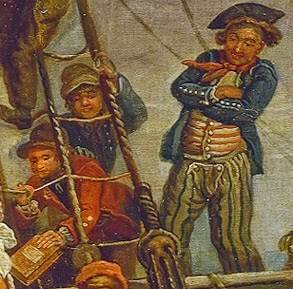
Detail from The Embarkation by John Collett,
circa 1760s, Nation Maritime Museum (UK)
Then as now, 18th century mariners were a distinctive fraternity.  Seafaring dress was clearly recognizable to contemporaries as such, though not all who wore it were active seamen and plenty of waterman plied their trade in landsmen's clothes. 

A detailed, ongoing study of documentation for sailor clothing of the period can be found at the excellent British Tars blog, and there has been fine research as well by such living history groups as Munro's Battoe- men and H.M.S. Somerset.

To add to this body of knowledge, I have analyzed colonial and revolutionary era newspaper references to sailor clothing between 1734 and 1782 as compiled and recorded in the New Jersey Archives.  I offer here a short assessment of these data, followed by every clothing description listed by year.

Blue was the most common, but by no means the only sailor jacket color. There are 16 references to blue sailor's jackets, most of which date from the mid 1760s or later.  There are also five references to brown sailor jackets, only one of which from the revolutionary-era.  There are four green, four light coloured, two black, two grey or lead coloured, one snuff-coloured, two that were either striped or spotted, one dark coloured, one black and blue and one striped red and white. 

Men from the same ship sometimes wore clothing of the same color and material provided from the ship's store.   In 1766 two murderers wore "light coloured sailor's jackets lined with white", while in 1763 six Scotsmen who had recently been transported from Leith on the Ship Boyd, Captain Dunlop, subsequently ran away taking with them "sailor's new short blue jackets, lined with white flannel."  Five men who ran from the Hannah, James Mitchell, Master, in August 1773 were wearing very poor and ragged clothing, but one is described as an apprentice and the others are unlikely to have been sailors, for the overcrowded Hannah had just crossed from Londonderry to Philadelphia with 520 Irish passengers.

Men Loading a Boat With Barrels by Samuel Scott (1702-1772)
Yale Center for British Art
Various textiles were used for sailor jackets.   Outer clothing made sailor fashion was often coarse or napped wool fabric like bearskin or kersey with properties suitable for resisting wind and water.  Thick cloth, Duffield, German serge, homespun and broadcloth are also mentioned in the New Jersey runaway ads, as is a swanskin flannel jacket.  Buttons when mentioned are quite varied.  Where a lining material is described, flannel or woolen is mentioned, colored either white or red.  Where a binding is noted, it is either white or a lighter color than the coat material.  Since jackets with binding along the edges and sleeve placets were commonly associated with seafaring dress, these may be under-represented in the runaway descriptions that simply mention sailor jackets.  

There were no Pea Coats, but there were Pea Jackets.   Possibly derived from the Dutch or Frisian "pijjekker" meaning a coarse cloth jacket, pea jackets have been associated with American and European sailors for centuries,  first referenced in the Boston Gazette in 1720.  The earliest reference to sailor clothing in my New Jersey study is to "an old sea-pea jacket, lined with red, and the skirts somewhat cattle eaten" worn by a runaway in 1734.  Two more references in the 1740s describe pea jackets and they continue to appear in these records through 1772.  There are nine in all. How a pea jacket at this time differed from a sailor's jacket is not apparent from the newspaper ads, nor whether they were broad lapelled and double breasted as was typical of later Pea Coats. One runaway servant in 1772 wore a long surtout over his pea jacket.  They are described in many different colors, but the only reference to cloth is a "dark kersey pea jacket, without lining."

The Sailmaker ticketing the hammocks on board [the Frigate] Pallas
by Gabriel Bray, November, 1774, National Maritime Museum (UK)


There are some early mentions of short jackets, But not enough to discern a trend. Short jackets, which may or may not have had skirts, are mentioned as early as 1763 in the NJ runway ads, and again in 1768.  On the other hand, a runaway in 1772 wore "a large blue sailor jacket, lined with white flannel, somewhat tarry."  Most descriptions do not mention jacket length at all.  Likewise, there are just two mentions of double breasted sailor jackets.

Other items of distinctive sailor dress are infrequently mentioned
.  Since most of the newspaper ads in this study describe runaways who happened to be wearing sailor's jackets but were in service on land, caution is needed when assessing their other clothing as indicative of nautical wear.  Three wore "sailor trowsers", one described in 1751 as wide sailor trowsers and fustian breeches under them.   The two murderous sailors who waylaid a man on the road in 1766 left behind their incriminating clothes: "one shirt and sailor's frock, both bloody, two pair of trowsers, one bloody, and two small marling spikes".  In 1768 A horse thief in a sailor jacket wore "long striped Cotton trowsers" and was described as having served on a man of war. 

There are just a couple of references to caps or hats.  Two of the hats have bound edges, one that is probably not cocked,  and another very unusual one worn by a slave from Barbados in 1769 who was apprehended in seafaring dress wearing "a white hat with red lining, yellow loop and button."  Two men wore caps - one of the murderers in 1766 had on "a sailor's cap", and  an Irish servant in 1768 who wore "a regimental cap turned up with red".

There are plenty of watermen in these NJ runaway ads who sailed and/or stole boats and wore regular clothing. Any sailor clothing that was described is listed below.

Scott Lance, Munro's Battoe-men
Washington Crossing, 2013

Sailor Clothing mentioned in NJ Runaway Ads 1734-1782


1734 an old sea-pea jacket, lined with red, and the skirts somewhat cattle eaten
1742 an old black pea jacket, mohair buttons, lined with white flannel
1744 a dark kersey pea jacket, without lining
1749 Blue Duffield sailor’s jacket, and a striped under jacket
1750 a snuff coloured pea jacket
1751 A brown pea jacket, and a blue one under it..
         ...wide sailor trowsers and fustian breeches under them
1756 an old bearskin [vest] made sailor fashion, patched on the elbows
1762 a redish brown sailor’s jacket
1763 a kersey sailor’s double breasted jacket, with horn buttons
1763 [a number of] sailors new short blue jackets, lined with white flannel
1764 an old lead coloured pea jacket, pieced on the sides with black
         (to make it big enough for him)
1765 a thickset coat, sailor’s trowsers, a great coat, and old hat
1766 [Murderers, two men dressed like sailors]
         light coloured sailors jackets, lined with white, the tallest
         had a sailor’s cap, the smallest a hat
        (leaving in the field one shirt and sailor’s frock, both bloody,
         two pair of trowsers, one bloody, and two small marling spikes)
1766 Irish servant an old blue sailor’s jacket, bound with white,
         with horn buttons, a red under jacket without sleeves, bound with white
1768 a sailor’s blue waistcoat and under waistcoat, a pair of new buckskin
         breeches, new fulled stockings, and a felt hat.
1768 a short blue sailor’s jacket, with the sleeves taken out, blue half thick
         trowsers, linen ditto
1768 a sailor’s napped vest
1768  a regimental cap turned up with red, an old brown jacket made
          sailor fashion, tow trowsers
1768  black and blue homespun vest, made sailor fashion, slashed sleeves,
          lined with flannel, with horn buttons, long striped trowsers
          (later described as: a new double breasted jacket, black and blue
          broadcloth, with slash sleeves, lined with flannel, and
          horn buttons…long stripped Cotton trowsers)
1768 a blue sailor’s jacket
1768 a thick cloth jacket light colour’d, lined with woolen, made sailor fashion
1768  a check shirt and a pair of white tow trowsers, a sailor’s brown jacket,
          a streaked vest
1769 a swanskin flannel jacket, made sailor fashion
1768  a sailor’s jacket with lace over the seams
1769 a blue sailor’s jacket, much worn and faded
1769  he was taken up in a seafaring dress, with a white hat, red lining,
          yellow loop and button, who says he is a slave of John Christian,
          of Bridgetown, Barbados,
1770 coarse light coloured cloth jacket, lined with red, made sailor’s fashion
1771 four sailor jackets, two blue, the others striped or spotted
1771 a large blue sailor jacket, lined with white flannel, somewhat tarry
1771 Green pea jacket and a check shirt
1771 a blue pea jacket
1772 a blue cloath sailor’s jacket
1772 an outside green pea jacket, and a red under one, a long blue
        surtout coat, long Oznaburg trowsers, and new shoes, a checked shirt,
        a very small rimmed beaver hat, and a Black silk handkerchief
        round his neck
1773 two waistcoats, sailor fashion made, one green the other grey
1773 a blue sailor’s jacket
1774 Two green cloth jackets, the upper one a sort of nap, made in the
          sailor fashion
1774 one homespun bearskin [ships] black jacket, one light coloured
         worsted and wool ditto, no lining in either, two ozenbrigs shirts,
         one new, the other half-worn, one pair of old leather breeches,
          new tow trowsers, black yarn stockings, two pair of shoes,
          about half worn, a good felt hat, almost new, and an old ditto,
          has been bound round the brim
1777  a brown sailor jacket, and an under ditto, near the same color,
          of German Serge, bound with binding something lighter; homespun
          shirt and trowsers, an old castor hat.
1777 a blue jacket made sailor fashion, blue breeches, a round hat
1778 thickset coat, striped linen jacket, sailor’s trowsers and thread stockings
1779 a sailor’s blue jacket and breeches
1780 striped red and white sailor’s outside jacket